
Crazy Time Live Casino Game Show in the UK
 Available in GB
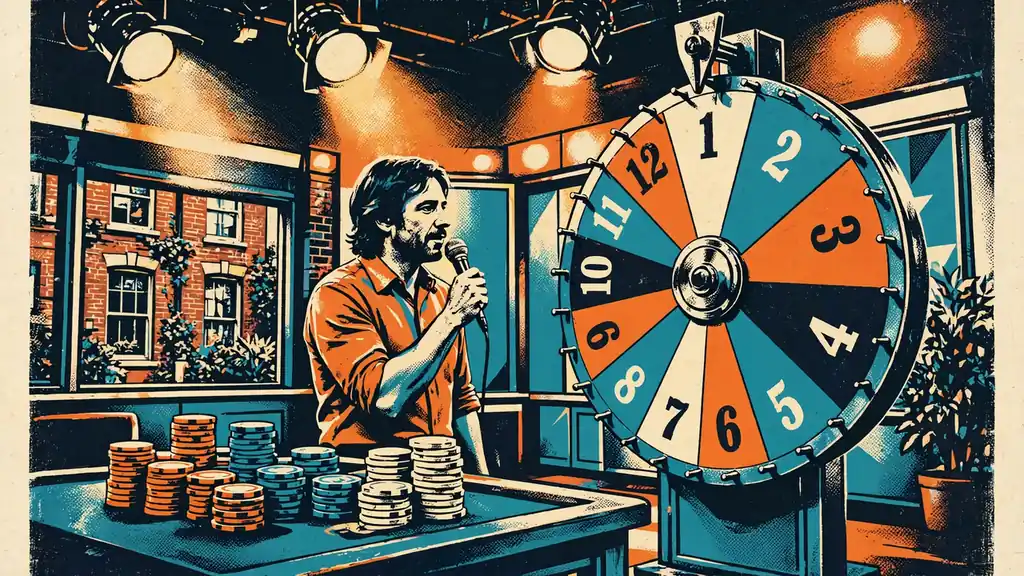
A practical guide to the live wheel format, demo limits, casino checks and the chance-based nature of Crazy Time.
Crazy Time Is a Live Wheel Game, Not a Slot
Crazy Time is a live casino game show built around a large wheel, a studio presentation and a real-time betting interface. It is not an online slot, even though both may appear in the same casino lobby and both involve wagering money on an uncertain outcome.
The distinction matters because the words “casino game” cover very different formats. A slot is software-led: symbols are generated on screen, usually across reels, and the result is produced by the game’s randomised mechanism. Crazy Time is presented as a live event. A host operates the show from a studio, the wheel is spun during the broadcast, and the result is shown as part of that session rather than represented by a reel animation.
That is the practical meaning behind phrases such as “Crazy Time live casino” or “live casino Crazy Time”. The live element is not merely a video placed around a digital game. The presentation, wheel spin and table activity are connected to an active studio feed. The interface normally combines the video stream with betting controls and information about the current round, so the experience sits closer to a televised game show than to a conventional casino slot.
I have seen the two categories placed side by side in casino menus, which is where much of the confusion begins. A search for a Crazy Time casino UK option may return pages discussing slots, live tables and game shows together. That does not turn Crazy Time into a slot, nor does a casino’s slot section become relevant simply because the same operator offers the game.
A live wheel game also has a different rhythm. A slot can often be opened and played through a sequence of individual spins within the game’s own interface. Crazy Time follows a hosted round: the betting phase opens, the available choices are displayed, the wheel is spun, and the outcome is settled before the next round begins. The studio pace therefore forms part of the product. Pauses, announcements and on-screen prompts are not decorative extras; they organise how the round is experienced.
Deal or No Deal Casino UK: Format and Game Details
The visual style can make the distinction less obvious. Crazy Time uses bright graphics, themed features and a presenter-led format, so it is deliberately more theatrical than a standard table game. Yet presentation should not be confused with control. A host can explain what is happening and keep the broadcast moving, but cannot make an uncertain result predictable.
The same applies to labels such as “casino Crazy Time UK”, “Crazy Time casino live” and “Crazy Time live casino UK”. They describe access to a live wheel game through an online casino interface, not a separate slot category or a guaranteed form of play. The relevant question is what the product actually is: a live, hosted wheel show in which wagers are placed before the result is revealed.
The format may be entertaining, but entertainment does not remove financial risk. Gambling should be limited to money that can be afforded to lose.
Top online casinos in the UK
- JetsetspinsBonus: 200% Bonus + 100 Free Spins + Free Royal Wheel · Payout speed: 1-3 business days
- x3betBonus: Welcome Pack 100% Up to £1.000 + 200 Free Spins · Payout speed: 1-3 business days
- SlotoSportBonus: 500% up to £ 10 200+ 777 FS · Payout speed: 1-3 business days
- NightLuckBonus: Welcome Pack + 805% Up To 6400€ + 280 FS · Payout speed: 1-3 business days
- Revery PlayBonus: 100% up to€1,000+ 100 FS · Payout speed: 1-3 business days
- BeOnBetBonus: 100% up to €500 + 100 FS · Payout speed: 1-3 business days
- NightWinBonus: £900 + 400 free spins · Payout speed: 1-3 business days
- WinBeastBonus: €5000 + 500 FS + €650 Freebet · Payout speed: 1-3 business days
The Rules, Multipliers and the Slot-Limit Distinction
Crazy Time uses a numbered wheel and four bonus segments. Before the spin, wagers can be placed on the sections marked 1, 2, 5 or 10, or on a bonus symbol. The wheel then determines the winning segment. A numbered result pays according to its face value, while a losing wager is removed from the round.
The bonus sections lead to separate game-show rounds rather than paying a simple fixed number immediately. Their formats differ, but the basic principle remains the same: the wheel selects the bonus, and the bonus round produces the final result. A multiplier can then increase a qualifying payout. That multiplier applies to the relevant winning outcome; it does not turn every wager in the round into a winner.
This is why descriptions of “casino scores” need careful reading. A score is not a prediction, rating or measure of skill. It is the result assigned to the winning section or bonus outcome. A large multiplier changes the potential return on a winning wager, not the probability that the wheel will land on that section. It also does not recover earlier losses.
Great Britain’s online slot controls set a maximum stake of £5 per game cycle for customers aged 25 and over, and £2 for those aged 18 to 24.
The slot-limit point is separate. A specialist review has stated that Great Britain’s online slot controls set a maximum stake of £5 per game cycle for customers aged 25 and over, and £2 for those aged 18 to 24. That statement concerns online slots, not casino games generally. The same type of source has also said that the controls do not cover roulette or blackjack. They should therefore not be presented as a blanket ceiling for every live casino game, or automatically applied to Crazy Time simply because it is played online.
The useful distinction is between the game’s own wager rules and a regulatory limit attached to a particular product category. Neither changes the underlying chance of the wheel. I keep the practical rule simple: stake only what can be afforded to lose.
What a Crazy Time Demo Can—and Cannot—Show
A Crazy Time casino demo is mainly an orientation tool. It can show how the game screen is arranged, where the wheel appears, how a round is presented and how on-screen controls respond. That makes a live casino demo useful for learning the sequence of a round before any real-money decision is considered.
The same applies to a Crazy Time demo casino accessed through a browser or mobile device. It may help establish whether the interface is readable, whether the animation runs smoothly and whether the game’s terminology is understandable. Those are practical details, especially when a first session involves a live video feed, chat panel and betting controls in the same window.
The label “demo slot” is less precise here. Crazy Time is not transformed into a slot because a page calls it a Crazy Time slot demo. A demonstration mode does not change the underlying game format; it only presents a no-stake version of the interface and round flow.
What it cannot show is how a future round will land. Demonstration results do not forecast real-money outcomes, reveal a dependable pattern or validate a staking system. A run of results in a Crazy Time live casino demo has no predictive force over later play.
Crash Casino Games in the UK: How to Assess Them
Conditions can also differ between demonstration and real-money modes. Available controls, account checks, table settings, game availability and interruptions may not be identical. A Crazy Time casino demo UK page therefore deserves to be treated as a preview, not a promise that every real-money session will look or operate in precisely the same way.
My practical rule is simple: use the demo to understand the screen, then keep money decisions separate. Any real-money play should be limited to what can be afforded to lose.
Free Play, Free Spins and the Conditions Behind the Label
“Free” is one of the least precise words in casino advertising. In a Crazy Time context, it can describe ordinary play without a cash stake, a promotional reward, or simply a headline intended to encourage an account registration. Those are different arrangements, and a Crazy Time casino review should keep them separate.
A no-stake version is generally about becoming familiar with the screen, controls and sequence of a round without risking deposited funds. It is entertainment and practice, not a source of winnings. Any displayed balance, result or reward in that setting should not be treated as money that can be withdrawn. The interface may also differ from the real-money environment, so “free casino game” does not automatically mean an exact replica of every account or table condition.
“Free spins” is a more complicated label for a live wheel game. The phrase is commonly associated with slot promotions, while Crazy Time is a live game-show format rather than a conventional slot. Where an operator uses the wording around Crazy Time, the important point is not the headline but what the offer actually grants. It may refer to a promotional credit, a particular game feature, or a campaign that merely includes the title in its description. The label alone establishes none of these.
The meaningful details sit in the terms:
- whether registration or a deposit is required;
- which games, stakes or account balances qualify;
- whether the reward is cash, bonus credit or no-stake access;
- whether winnings can be withdrawn;
- when the promotion starts and ends;
- what happens if the account is closed, a wager is cancelled or the offer is not activated.
Promotional wording can make a restriction sound like a benefit. “Free” may mean that the casino supplies the initial value, not that every resulting win is immediately available as cash. I have seen the difference matter most at withdrawal stage, when a player discovers that an attractive banner was only one part of the arrangement.
A safe Crazy Time casino UK assessment therefore treats free-play claims as terms to verify, not as proof of value or safety. The operator must be authorised for British customers, and the UK Gambling Commission licence number should be checked on its public register before depositing. Free access does not remove the need for care: gambling should be limited to money that can be afforded to lose. Free is not unconditional.
How Crazy Time Fits into an Online Live-Casino Lobby
An online live casino is organised around streamed play rather than a static software interface. A presenter or dealer operates the game in a studio, while the platform sends the video, game controls and result information to a remote screen. Crazy Time belongs to this broadcast-led environment: it is presented as a live game-show experience within a casino lobby, not as an isolated download or a conventional reel game.
Casino Dice Game UK: How Wagers and Odds Work
That distinction matters when looking at a “Crazy Time online casino”. The casino site is the access layer; the game itself remains a product supplied and operated within the live-casino section. A lobby may place it beside card tables, roulette streams and other wheel-based shows, with each title opening its own table or studio feed. The surrounding menus can make the products look similar, but the underlying formats can be quite different.
I have seen this confusion from the operator side. A player searches for an online casino with Crazy Time, arrives at a page showing a broad casino catalogue, and assumes that every title is available in the same way. In practice, the lobby may separate live games from slots, table games and virtual products. Some titles may be visible only after selecting the live section, while a mobile layout can place the relevant category behind a compact menu.
The lobby is a catalogue, not a single game
A live-casino lobby usually has several layers:
- a live section containing streamed tables and game-show formats;
- categories for roulette, blackjack and other card games;
- game tiles showing the title, studio or table identity;
- a panel for opening the game and viewing the available betting interface;
- account, balance and session controls supplied by the operator.
Crazy Time can therefore sit alongside a roulette table without sharing roulette’s presentation or mechanics. A roulette stream is centred on a wheel and a dealer’s procedure. A blackjack table is structured around cards, decisions and a dealer. A game-show title may use a presenter, a large studio set and a more theatrical sequence. The common feature is the live presentation, not identical gameplay.
Live Dream Catcher Casino UK: What to Check
This is also why “casino online Crazy Time” can describe several different experiences at once. One site might show the game in a dedicated live-games menu; another might group it under game shows; another might display it through a provider-led lobby. The title and visual identity may be recognisable, while the surrounding navigation, account tools and table availability vary between operators.
Grosvenor’s history illustrates the wider development of this category without proving anything about a particular Crazy Time listing. The operator first introduced live casino games in 2013, with card and casino formats including Blackjack, Texas Hold’em and Roulette. That launch reflects how online casinos developed live sections as a broader service: streamed tables became a separate part of the product range, rather than simply another type of casino software.
What changes between live tables
The main difference is the relationship between the player and the studio. A standard casino interface generates results through software and presents them graphically. A live table shows a real-time studio feed, with a presenter or dealer handling the visible procedure. The lobby must then coordinate the video stream with the game controls, account balance and result history.
That can affect the practical feel of a session. A table may have a waiting state while the next round is prepared, an on-screen countdown before decisions close, or a chat panel alongside the broadcast. These are interface features, not evidence that the outcome is more predictable. The live setting changes how the game is delivered, not the role of chance in its results.
It also explains why a casino online Crazy Time UK page should not be judged by its title alone. A search result or promotional tile can identify a game, but it does not describe the whole lobby: how the live section is arranged, which controls are available, or whether the displayed title is actually open for play at that time. Those details belong to the operator’s current interface and terms.
Mines Casino Game UK: Demo, Randomness and Real Play
Live casino play remains gambling. Age verification is required before an operator allows deposits, and responsible-gambling controls are part of the regulated online environment. Any session should be funded only with money that can be afforded to lose. Short remark: presentation is not protection.
Where to Play: Licence Checks Before Game Searches
A website displaying the Crazy Time wheel is not, by itself, evidence that the operator may legally offer it to customers in Great Britain. Availability is a separate question from presentation. A game can appear in a lobby, promotional page or mobile interface while the operator’s regulatory position still requires checking.
For British customers, the starting point is the operator rather than the game title. Remote gambling businesses serving Great Britain must hold the relevant licence from the UK Gambling Commission, even when their technical equipment, company offices or game infrastructure are located elsewhere. The location of the wheel’s studio does not replace the operator’s licensing obligation.
The Commission is the sole regulator for commercial gambling in Great Britain. Its remit includes online casinos and other remote gambling supplied to consumers in the market. That makes the public register more useful than a badge, footer statement or “licensed” claim placed on a casino website.
What to check before opening an account
The register check should identify the legal business behind the casino, not merely confirm that a familiar brand name appears somewhere online. A practical check involves:
- matching the operator’s trading name with the business named in the register;
- checking that the listed permission covers remote gambling supplied to Great Britain;
- comparing the registered website or domain with the address being used;
- confirming that the licence is current before any deposit is made.
The Commission grants operating licences to businesses and personal licences to individuals who operate within Great Britain. For a customer deciding where to play Crazy Time, the operating licence is the relevant part of that distinction. A personal licence belonging to an individual does not, on its own, establish that a casino website is authorised to accept remote players.
This is also why a direct licence-number check matters more than a claim that a casino is “trusted”. Marketing language can remain unchanged after a domain, ownership structure or operating arrangement has changed. The register provides a more precise point of reference: which business is licensed and which website is connected to it.
What a licensed operator should provide
A UK Gambling Commission licensee must have an internal complaints process and provide access to an approved Alternative Dispute Resolution service. Those arrangements matter if a withdrawal, account decision or transaction develops into a formal dispute. They do not promise a favourable result, but they establish a route for raising the issue.
Licensed casinos must also provide responsible-gambling controls, including self-exclusion. Age verification is required before a customer can deposit funds, so the account-opening process is not simply a formality before joining a live table. Remote operators must also prompt new customers to set a financial limit before the first deposit and make account-level limit controls accessible.
Chicken Road Game in UK Casinos: Format and Context
Payment rules provide another useful distinction. UK-licensed casinos cannot accept credit cards for gambling, including credit-card funding routed through a money service business or wallet where credit-card funds can be used for gambling. An unusual payment route is not a sign of flexibility; it can be a reason to pause.
I have seen game availability treated as the main test and licensing as an afterthought. That reverses the sensible order. First establish who is authorised to serve Great Britain, then examine whether Crazy Time is actually offered under that account. Only gamble what can be afforded to lose.
Assessing a Crazy Time Casino Without a “Best” List
A casino offering Crazy Time should be assessed as a gambling operator first and a game destination second. A polished page, a prominent Crazy Time logo or a long list of live tables does not establish that the business may legally accept players in Great Britain. I would start with the operator behind the site, then verify the exact domain and licence details before considering the game lobby.
Attention A visually polished page or a prominent logo does not guarantee that a casino is authorised to accept players in Great Britain.
The relevant authority is the UK Gambling Commission. It regulates commercial gambling in Great Britain and issues operating licences to businesses, alongside personal licences for individuals involved in operating gambling activities. A remote operator serving consumers in Great Britain must hold the appropriate Commission licence, regardless of where its equipment or company offices are located.
That makes the public register the first practical checkpoint. The brand name and the web address should match what appears in the register. A licence displayed in a footer is not enough if it belongs to another company, another domain or a different trading name.
A brand is not the same as a licensed operator
Casino branding can obscure the legal entity that actually accepts deposits and pays winnings. Several related domains may look similar while being operated by different businesses, or a marketing page may refer to a brand without clearly identifying its licence holder. The check therefore has three parts:
- Identify the company named in the casino’s terms.
- Compare that company with the operator shown on the Gambling Commission register.
- Confirm that the domain used for registration and deposits is covered by the relevant entry.
This is particularly important when a site promotes itself as a place for Crazy Time in the UK. A game being visible on a page does not prove that the page belongs to a licensed casino, and a search result does not replace an operator check.
One specific warning concerns LuckyPays. A specialist review records that a public Gambling Commission register check dated 26 September 2026 found no LuckyPays entry under the brand or the stated domain, including luckypays.io. That is a reason to verify the brand and domain independently, not to treat promotional claims as evidence of authorisation. Register information can change, so the check should be made against the live record before any deposit.
Examine the account terms, not just the game menu
Once the operator’s identity is clear, the terms reveal how the account works. The important points are not limited to the Crazy Time rules. They include:
- the legal company accepting the account;
- the applicable licence information;
- age-verification arrangements;
- deposit, withdrawal and identity-check conditions;
- account closure and self-exclusion procedures;
- the complaints route and access to an approved Alternative Dispute Resolution service;
- the responsible-gambling controls available within the account.
Operators must verify a customer’s age before allowing deposits into a gambling account. Remote operators must also prompt new customers to set a financial limit before the first deposit and provide account-level controls for changing limits. These features are part of the operating framework, not optional decoration on a responsible-gambling page.
Credit cards cannot be used for gambling with UK-licensed casinos. The restriction also covers credit-card funding routed through a money service business, and wallets cannot be used where their funds come from a credit card for gambling. A casino’s payment page should therefore be read alongside its terms rather than judged by the number of logos displayed.
Separate availability from suitability
A casino may carry Crazy Time and still be unsuitable for a particular account holder. The game’s presence answers only one question: whether the operator has placed that title in its live lobby. It says nothing about the clarity of its withdrawal terms, the quality of its dispute process or whether its account controls are easy to find.
I also look for language that turns a condition into a sales phrase. “Fast withdrawals” may sit beside verification requirements, payment-method restrictions or a review process. “Exclusive access” may describe a lobby arrangement rather than a special legal status. “Trusted” is a marketing description until the company, domain and licence can be matched.
The same discipline applies to bonuses, although a headline offer should never be treated as a reason to overlook licensing or account terms. The conditions governing eligibility, use and withdrawal determine what the promotion actually does. If those conditions are difficult to locate, that is useful information about the operator’s transparency.
A practical comparison without a ranking
There is no sound basis for calling one Crazy Time casino the “best” for every player. A more reliable comparison records the same checks for each candidate:
- Is the operating company identifiable?
- Does the Gambling Commission register match the brand and domain?
- Are age checks and financial-limit controls explained?
- Are credit-card restrictions reflected in the payment options?
- Are self-exclusion tools available?
- Is there an internal complaints process and an approved ADR route?
- Are the terms readable enough to understand before depositing?
This produces a decision based on verifiable operating details rather than a ranking built from advertising language. I would also check whether the intended domain remains the one covered by the licence immediately before opening an account, especially where a brand uses several web addresses.
Crazy Time can be one title in a legitimate live-casino lobby, but the game should not be allowed to carry the operator’s credibility. Any gambling session should use money that can be afforded to lose, with account limits set before play begins. That is the useful standard: verify the business, read the conditions, and treat the game catalogue as only one part of the assessment.
A “Strategy” for a Game Built Around Chance
The phrase “Crazy Time strategy” suggests that a repeatable method can turn the game in the player’s favour. In practice, the useful part of any Crazy Time live-casino strategy concerns decisions around the wager, not control over the wheel. The result of an individual round is not made predictable by a previous result, a preferred position, or a pattern spotted on screen.
I have seen strategy advice become less about probability and more about presentation: a run of outcomes is given a name, a sequence is drawn across a chart, and the language of a “system” makes ordinary chance look organised. That can be persuasive without being informative. A sequence may look unusual, but its appearance does not create an obligation for the wheel to correct itself in the next round.
What a player can control
A sensible Crazy Time casino game strategy starts with the parts of the session that belong to the player:
- the size of each wager;
- the total amount set aside before play begins;
- the point at which the session ends;
- whether a losing run changes the planned stake;
- whether winnings remain in the account or are withdrawn from play.
These are financial decisions, not methods for forecasting the result. A smaller wager can reduce the speed at which a balance changes, but it cannot improve the outcome of the next spin. A session limit can stop a sequence of losses from becoming an open-ended chase, but it cannot recover money already lost.
Remote operators must provide account-level limit controls and prompt new customers to set a financial limit before making a first deposit. Those controls are more practical than a betting progression dressed up as a system. Increasing a wager after a loss does not make the next result more likely to win; it only increases the amount exposed if another unfavourable result follows.
Any plan should also include the basic rule that gambling money must be money that can be afforded to lose. Borrowed funds, essential household money and credit-card funding are not a sensible foundation for a session. UK-licensed casinos cannot accept credit cards for gambling, but a payment restriction is not a substitute for a personal budget.
Controlable elements
The Crazy Time strategy is limited to decisions around your wager, not control over the wheel.
- The size of each wager
- The total amount set aside before play begins
- The point at which the session ends
- Whether a losing run changes the planned stake
- Whether winnings remain in the account or are withdrawn
Trackers record history, not the future
A Crazy Time tracker, whether built into a casino interface or kept as a personal record, can show what has already happened. It may help identify how quickly a session is progressing, how often the player is increasing stakes, or how easily a planned stopping point is being ignored. That is its realistic value.
A tracker cannot make a random outcome “due”. The same limitation applies to claims about a casino tracker, a Crazy Time tracker in the UK, or a chart labelled as a prediction tool. Past results can be counted and displayed; they cannot be converted into a reliable instruction for the next spin.
This distinction matters because a record can create false confidence. After several similar results, the temptation is to expect a change. After a long absence of a feature, the temptation is to call its return likely. Both reactions confuse description with prediction.
A practical test for strategy claims
When assessing Crazy Time casino strategies, the important question is what the method actually changes. If it changes only the timing or size of wagers, it is a money-management routine. If it claims to forecast the wheel, guarantee a return, or overcome chance through a tracker, the claim goes beyond what the record can establish.
The history of Crazy Time, or casino history more generally, may explain how live game shows became part of online casino lobbies. It does not supply a winning formula for present play. The honest strategy is therefore limited but useful: set boundaries, keep stakes consistent with those boundaries, stop when the limit is reached, and do not treat a sequence as a signal.
JetX Casino Game in the UK: Format and Play
Crazy Time Bonuses and Deposit Terms
A “Crazy Time bonus” is not a single product with fixed rules. It is marketing language attached to an offer whose value depends on the written terms. The headline may mention a welcome bonus, a deposit bonus or a no-deposit reward, but none of those labels explains when the credit appears, what games qualify or how a withdrawal is handled.
The first distinction is between cash and bonus balance. A deposit can be real money added to the account, while promotional credit may be separated from the withdrawable balance. The terms should state whether the bonus is released immediately or only after specified play conditions are met. They should also explain whether winnings connected with the bonus can be withdrawn, and whether unused promotional credit expires.
A Crazy Time casino bonus UK customers see may carry conditions about the eligible deposit method, account verification, minimum qualifying activity, excluded games or a maximum amount that can count towards the offer. Those details matter more than the promotional phrase. A live game may be visible in the lobby yet excluded from a particular promotion, or it may contribute differently from other casino games. The offer wording is the controlling document.
“Free” needs the same scrutiny. A no-deposit bonus does not automatically mean cash that can be withdrawn without conditions. It may be available only after registration checks, may require a qualifying action, or may restrict the games and transactions connected with it. If the terms do not clearly explain the trigger and withdrawal treatment, the label has little practical meaning.
Deposit terms should also be read separately from bonus terms. UK-licensed operators must not accept credit cards for gambling, including certain credit-funded wallet routes. New customers must be prompted to set a financial limit before the first deposit, with account-level controls available afterwards. Age verification is required before depositing funds.
Promotional credit is not a reason to increase a stake or chase a payout. Only money that can be afforded to lose should be used for gambling, whether a bonus is attached or not. I treat an offer as acceptable only when its balance rules, qualifying activity, expiry wording, excluded games and withdrawal process are understandable before the deposit is made. If those conditions are buried or ambiguous, the headline is doing more work than the offer.
Live Casino Games Beyond Crazy Time
Crazy Time sits within a wider live-casino catalogue rather than standing as a separate type of gambling. The common thread is the live presentation: a real-time studio or table format, with the game displayed through an online interface. That makes the surrounding catalogue relevant when comparing the role of a wheel show with more familiar casino formats.
The wider selection includes:
- Blackjack, a card game built around the value of the dealt hand.
- Roulette, where the outcome is associated with a numbered wheel.
- Texas Hold’em, a poker format played with shared cards and individual hands.
- Infinite Blackjack, a live blackjack product designed to accommodate additional online players.
- Lightning Roulette, a live roulette product with its own presentation and game features.
- Dream Catcher, another live wheel game.
- Common Draw, a live draw-style product.
These names describe different formats, not interchangeable versions of the same game. A wheel show such as Crazy Time has a different rhythm from blackjack, while roulette is organised around a wheel outcome rather than a card hand. Texas Hold’em also belongs to a different family because the structure is poker-based. The distinction matters when casino pages place several products under one “live” heading and the label makes them appear more alike than they are.
I have found that the most useful comparison is not which title looks most prominent in a lobby. It is what the format asks the player to follow. Blackjack requires attention to the hand and the available decisions. Roulette centres on the selected wheel positions and the resulting spin. A live draw or wheel show places more emphasis on the host, the presentation and the event sequence. None of those differences changes the fact that the result remains uncertain.
The UK live-casino market did not begin with game-show wheels. Grosvenor introduced its live-casino offering in 2013, with card and casino games that included Blackjack, Texas Hold’em and Roulette. That history helps place Crazy Time in context: it is part of an expanding live format, alongside established table games and newer studio products, rather than a replacement for them.
A casino lobby can therefore contain several layers at once. Traditional table games may sit beside branded live products, while separate entries may use similar camera, dealer or studio presentation. Product names can also be confused with operator names. Infinite Blackjack and Lightning Roulette are game titles; they are not evidence by themselves of who hosts, supplies or makes a particular casino available.
Search results and promotional pages often compress this distinction into phrases such as “the best Crazy Time casino” or “live casino results”. Those descriptions do not create a meaningful category. A result shown in a live interface is simply the outcome of that game round, not proof that one surrounding casino is better than another. Likewise, the presence of Crazy Time casino bonuses does not make the associated live games equivalent, and a promotion does not alter the underlying format.
My own rule is to identify the game first, then separate it from the lobby, the operator and any offer attached to the account. That avoids treating a familiar title as a quality mark for every product displayed beside it.
Live casino remains gambling, whatever the presentation. Stakes should be limited to money that can be afforded to lose, and a session should stop when that boundary has been reached. The host, graphics and table atmosphere may make the experience feel more immediate; they do not turn uncertain results into predictable ones.
Are online casino games licensed and regulated?
Yes. The UK Gambling Commission regulates remote gambling offered to consumers in Great Britain, and operators serving them must hold the relevant licence.
What are the online slot stake limits in Great Britain?
The maximum stake is £5 per game cycle for adults aged 25 and over, and £2 for adults aged 18 to 24. These limits apply to online slots, not roulette or blackjack.
Is LuckyPays licensed by the UK Gambling Commission?
The Gambling Commission register dated 26 September 2026 does not list LuckyPays under its brand or stated domain, including luckypays.io. Remote operators serving Great Britain consumers must hold the relevant licence.