
Online Casino Game Shows in the UK: How They Work
 Available in GB
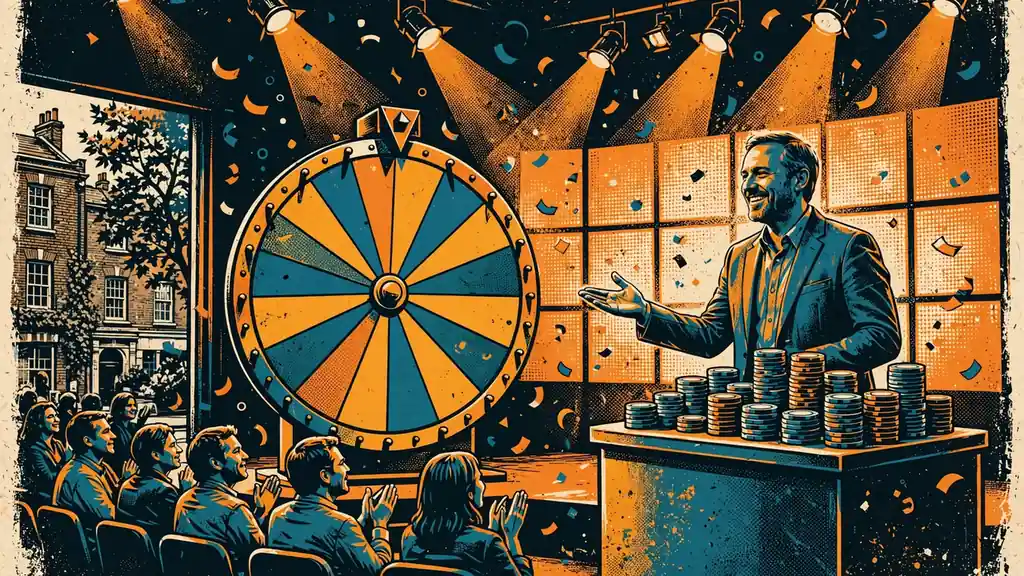
Live game shows combine chance-based betting with a hosted broadcast, while standard casino games present outcomes through software.
How Live Game Shows Differ from Standard Casino Games
Live game shows sit between two familiar categories: casino gambling and televised entertainment. The result is still determined by chance, and money may be placed on an outcome, but the presentation is built around a hosted show rather than a silent game screen. A presenter, studio set, visual effects, scripted announcements and timed rounds create a broadcast-style layer around the betting.
That distinction matters because the phrase “live” can mean several things in online gambling. It does not simply mean that a game opens in a browser, nor does it guarantee a particular format. A live game show normally involves a streamed presentation in which events unfold as part of a shared session. The interface carries the betting options and account functions; the video feed supplies the visible show.
A standard online casino game is generally more self-contained. A digital reel game, electronic table game or automated card game presents its rules and outcomes through software. The player selects a stake, chooses an available option where relevant, and starts the round. The game then produces an outcome without a presenter needing to introduce the action or maintain a broadcast.
Best EGT Online Casinos UK? How Amatic Fits
The difference is therefore not only visual. It affects timing, interaction, information and the way the product feels while in use.
A hosted format rather than a silent interface
The clearest feature of live casino game shows is the presence of a host or presenter. The presenter guides the session, explains what is happening, announces stages of the round and keeps the pace moving. The show may also contain graphics, sound effects, branded visual elements and other production devices associated with television or streaming content.
In a conventional casino game, the software is the visible authority. Buttons, symbols, cards, reels, menus and result panels perform the explanatory work. Any animation is part of the game design, not a person speaking to an audience. The experience can be polished and visually elaborate, but it remains software-led.
In a live show, the software becomes a control and information layer around a broadcast. It displays the betting window, the available choices and the resulting information while the streamed presentation gives the session its identity. This is why an online casino with live game shows can feel different from a casino containing only automated titles, even when both are accessed through the same account and website.
No-Limit Online Casinos in the UK: What It Means
The word “show” also sets an expectation about pacing. The product is arranged as a sequence of stages: an opening, a period in which selections can be made, a point at which betting closes, the event that determines the result, and the settlement that follows. The exact structure varies by product, but the format is more deliberately staged than a single software command followed by an immediate screen response.
How the round unfolds
Most standard digital casino games are designed around individual actions. A spin, deal or play command starts a round, and the result appears within the game interface. The next round can often begin as soon as the current one has finished. The player’s attention is concentrated on the screen and on the available controls.
A live game show works to a schedule created by the studio or broadcast system. There may be a period in which the betting options are open, followed by a visible closing point. The result is then revealed as part of the ongoing presentation. A participant who arrives after betting has closed may have to wait for the next round instead of starting a separate round immediately.
Barcrest Online Casinos in the UK: Games and Licensing
This shared rhythm is one of the format’s defining characteristics. A standard game can feel private and on-demand: the action begins when the individual control is pressed. A live show is closer to joining an existing session. Other people may be watching the same round, while the host and production system continue regardless of any one participant’s activity.
That does not mean every live product offers the same waiting time, sequence or interaction. Those details belong to the individual game’s rules and platform design. The general distinction is that the session follows a broadcast timetable rather than being generated solely in response to one player’s button press.
The role of the presenter
A presenter changes the nature of the information on screen. In an automated game, the rules are normally conveyed through a help panel, paytable, information icon or other static material. In a hosted show, the presenter may repeat the stage of the round, explain what is about to happen and announce the outcome as it occurs.
A live game show involves a streamed presentation in which events unfold as part of a shared session, using a video feed to supply the visible show.
This can make a complex interface easier to follow, but it also adds a performance element. The host’s tone, the studio design and the pace of the announcements become part of the product. They do not alter the underlying betting terms. A lively presentation cannot turn an unfavourable rule into a favourable one, and an entertaining broadcast does not change the fact that the outcome is governed by the game’s stated mechanism.
That separation is important. Marketing language often uses words such as “immersive”, “interactive” or “exciting”. In practical terms, these usually describe the way the product is presented, not a different standard for determining results. The show may be more engaging to watch, but its entertainment layer should not be confused with control over the outcome.
I have seen this distinction get blurred in product descriptions. “Interactive” sounds as though participation might influence the result. Often it means no more than selecting an option, joining a round, using a chat function or responding to a visual prompt. The meaningful question is what the rules say determines the result.
Interaction is broader, but not unlimited
Live game shows often offer more visible interaction than standard automated casino games. A participant may choose between displayed options, place a selection during an open betting period, or use chat and other interface features where the platform provides them. The session may also show activity from a wider audience.
These features can make the product feel communal. A standard digital slot or automated table game usually presents only the individual account’s activity. A live show can create the impression of a room or audience, even though the betting decision remains personal and the account balance remains separate.
Interaction should still be described precisely. Being able to choose an option does not necessarily mean the choice changes the underlying probability in the way a skill-based decision would. Joining a shared round does not mean another participant’s selection controls the outcome. A chat window does not become part of the game’s rules merely because it appears beside the video.
Best IGT Online Casinos UK: IGT and Amatic
The useful distinction is between participating in the presentation and determining the result. The first may involve controls, selections or social features. The second is governed by the rules and outcome mechanism specified for that product.
Automated play and live presentation
Conventional online casino games rely on software to produce and display each round. This is true even when the game imitates a physical table or uses animated cards and reels. The visual design may borrow from a real casino, but the experience is still generated within the digital interface.
A live show introduces a broadcast feed into that process. The visible event takes place within the presented session, while software handles the account, betting interface, timing and settlement functions. The two layers work together: the studio supplies the show, and the platform supplies the digital means of joining it.
This arrangement can create practical differences. A video stream may have connection or loading requirements that do not apply in the same way to a simple software game. The screen may contain several panels at once, including the broadcast, betting controls, information about the current round and any available chat or activity display. A standard game may have fewer moving parts because it does not need to coordinate a live feed with a scheduled event.
The presence of video does not, by itself, establish that a game is a live game show. A recorded animation, simulated presenter or pre-rendered sequence can make an automated product look like a broadcast. The defining question is whether the format actually operates as a hosted, live session rather than merely borrowing television-style graphics.
The importance of timing
Timing is central to the difference between the two formats. Automated games are commonly organised around the speed of the individual session. The participant starts a round, sees the outcome and decides what to do next. The product is designed for repeated, self-directed play.
Timing
Unlike automated games, live shows follow a broadcast timetable where betting windows and results are part of a scheduled sequence.
A live show places the individual within a timetable. Betting may open, remain available for a defined stage and then close before the result is revealed. The next opportunity arrives as part of the programme’s sequence. Even where rounds follow one another quickly, the participant is joining the same flow as everyone else in that session.
This affects how the product is experienced. The pause before a result may be part of the entertainment rather than an empty delay. The presenter’s announcement, the visual build-up and the reveal provide a narrative arc that an automated game may not need. Conversely, anyone seeking complete control over the pace may find a scheduled show less direct than a self-contained digital game.
Neither structure is automatically better. They suit different preferences. The live format is built around shared timing and presentation; the standard format is built around immediate, individual control.
Rules remain more important than atmosphere
The appearance of a studio, the presence of a host and the sound of an audience can make a live product look very different from a conventional casino game. The core questions, however, remain familiar. What outcomes can be selected? When does betting close? How is the result determined? What is paid when a particular result occurs? Are there exclusions, limits or conditions attached to the available options?
These details belong to the game’s rules rather than its production style. A well-produced show can still have a complicated pay structure. A plain interface can still present rules clearly. The visual energy of a product should not be treated as evidence of its value, fairness or suitability.
This is where broad labels such as “best live casino game shows” become less useful than a description of the actual mechanics. “Best” might refer to presentation, pace, range of betting options, clarity of rules or the level of interaction. Those are different measures. Without separating them, a ranking becomes an advertising phrase rather than an assessment.
Amatic Online Casinos in the UK: Games and Licensing
The same caution applies to the phrase “online casino game shows”. It identifies a format, not a single type of game. One show may revolve around a simple choice, while another may use several stages or bonus-style features. The shared characteristic is the hosted, show-led presentation, not an identical set of rules.
Live does not mean personal control
The strongest misconception surrounding live casino game shows is that a visible human presence makes the result more controllable. It does not. A presenter can guide the session, but that does not give the presenter discretion to change an outcome. A participant can make a selection, but that does not automatically turn the activity into a game of skill.
The broadcast makes events easier to watch. It does not necessarily make them easier to predict. In fact, the show format may draw attention towards the reveal and away from the less dramatic parts of the rules. That is why the interface, help material and terms matter as much as the studio presentation.
A useful working description is simple: a live game show is a remote casino product organised as a hosted broadcast, with digital betting and account functions attached to the presentation. A standard casino game is primarily an automated software experience in which the interface generates and displays the round.
The two formats can appear side by side on the same casino website, but they ask for different kinds of attention. One is centred on the show’s shared rhythm; the other on the individual command. One uses a presenter and broadcast production; the other relies mainly on software and interface design. In both cases, the deciding information is found in the rules, not in the atmosphere.
Summary
- Live game shows are hosted broadcasts with digital betting layers.
- A presenter manages the pace but does not control the underlying game outcomes.
- Interaction in live shows is about participating in the presentation rather than determining the result.
- Standard digital games are built around immediate, individual control and software-led results.
Top online casinos in the UK
- JetsetspinsBonus: 200% Bonus + 100 Free Spins + Free Royal Wheel · Payout speed: 1-3 business days
- x3betBonus: Welcome Pack 100% Up to £1.000 + 200 Free Spins · Payout speed: 1-3 business days
- SlotoSportBonus: 500% up to £ 10 200+ 777 FS · Payout speed: 1-3 business days
- NightLuckBonus: Welcome Pack + 805% Up To 6400€ + 280 FS · Payout speed: 1-3 business days
- Revery PlayBonus: 100% up to€1,000+ 100 FS · Payout speed: 1-3 business days
- BeOnBetBonus: 100% up to €500 + 100 FS · Payout speed: 1-3 business days
- NightWinBonus: £900 + 400 free spins · Payout speed: 1-3 business days
- WinBeastBonus: €5000 + 500 FS + €650 Freebet · Payout speed: 1-3 business days
What UK Casino Licensing Says About Live Show Games
That distinction matters when comparing live game shows casinos, online casinos with live game shows, or any other operator category. A page may promote a particular style of content, but the wording used in an advert does not establish the legal status of the operator behind it. Licensing belongs to the business providing the gambling service, not to a marketing phrase such as “live casino”, “game show casino” or “best live game shows”.
Who regulates remote casino gambling?
The UK Gambling Commission oversees commercial gambling in Great Britain, including casino activity delivered remotely. In practical terms, this places online casino operations within the Commission’s regulatory system even when the customer never visits a physical venue.
The key point is that the location of the equipment does not decide whether the activity falls within that system. A company may use servers, studios, software infrastructure or other technical equipment outside Great Britain and still be offering remote gambling to consumers in Great Britain. The relevant connection is the service being offered to the market, not simply where the hardware happens to be.
That is why a casino carrying live show content cannot treat an overseas technical setup as a substitute for a UKGC licence. The operator’s internal structure may be international, but the service offered to British customers remains subject to the applicable British remote gambling requirements.
Wazdan Online Casinos in the UK: Provider Check
I have seen licensing described as if it were a label attached to the game itself. It is not. A live show may be supplied by one business, displayed through another business’s website and funded through a customer account held by the operator. The regulatory responsibility for the gambling service still has to be located in the licensed operation that offers the activity.
The operator’s licence is the important starting point
A UKGC licence is an operating authorisation for the business conducting the relevant gambling activity. It is not a general endorsement of every title that might appear in a casino lobby, nor is it a ranking of the operator’s catalogue.
This is especially important when looking at online casinos with live game shows in the UK. The appearance of a game-show section, a live table section or a promotional page does not by itself prove that every part of the offering has been assessed in the way a customer might assume. The licence establishes the operator’s regulated status; it does not turn every editorial description into a separate regulatory classification.
The same principle applies in the other direction. The absence of a visible reference to a game show on a general casino page does not establish that the operator cannot offer such content. Catalogues change, content can be supplied through different arrangements, and availability can be limited by account, territory or time. Licensing information and product availability answer different questions.
The first question is: is the business authorised to provide remote gambling to the relevant market?
The second is: does that business currently offer the particular live show content being considered?
Those questions should not be collapsed into one.
What the Gambling Commission does
The Gambling Commission is the central regulator for commercial gambling in Great Britain. Its remit covers gambling activity, including remote casino services, rather than only the software or entertainment visible on screen.
The Gambling Commission
The Commission grants operating licences to businesses and personal licences to individuals. An operating licence concerns the company providing the gambling service, while a personal licence concerns an individual working in a position that requires authorisation.
The Commission grants operating licences to businesses. It also issues personal licences to individuals whose roles fall within the relevant licensing arrangements. These are separate functions. An operating licence concerns the company or other business entity providing the gambling service, while a personal licence concerns an individual working in a position that requires personal authorisation.
That difference is easy to lose in promotional material. A company may refer to licensed management, approved technology or regulated games, but none of those descriptions replaces the need to identify the licensed operator responsible for the consumer-facing gambling account.
For a live show service, the operational chain may contain several parties. One may provide the game or broadcast element. Another may provide the website, account system, payment process and customer relationship. The licensing question attaches to the regulated activity being offered to the customer. A supplier’s position should not be confused with the operator’s position.
This is why the phrase “licensed game” can be imprecise. A game may be supplied by a legitimate business, but the customer still needs to know which operator is taking the bet. The operator is the party whose terms govern the account and whose licence is relevant to the consumer-facing service.
Great Britain and the wider UK wording
The everyday phrase “UK online casino” can hide a geographical distinction. The Gambling Commission regulates remote gambling offered to consumers in Great Britain. Great Britain means England, Scotland and Wales. Northern Ireland has a separate legal position and is not simply covered by the same regulatory description.
Betsoft Online Casinos UK: Listings and Claims
That distinction should remain visible in careful licensing language. A casino’s statement that it serves “UK players” may be commercial shorthand, while the Gambling Commission’s remote-gambling remit is framed around consumers in Great Britain. A broad label should not be treated as proof that the same regulatory route applies in every part of the United Kingdom.
For live game shows, this matters because availability and legal status are not established merely by a country selector, a translated page or a list of currencies. The operator’s actual authorisation and the market it is permitted to serve are the relevant points.
In internal reviews, I treat the geographical wording as more than a legal footnote. It prevents a common mistake: taking a general “UK casino” claim and assuming that the same licence, product range and protections automatically apply across every jurisdiction described by that phrase.
What a licence does not prove about live game shows
A UKGC licence confirms the regulated status of the operator within the scope of its authorisation. It does not, on its own, prove any of the following:
- that the operator currently lists live game shows;
- that a particular game-show title is available;
- that the content is available to every customer;
- that the content is available at every time;
- that a promotional page reflects the current casino lobby;
- that a supplier or studio is itself the customer-facing operator;
- that a particular live show is included in every version of the operator’s website or app.
This is not a criticism of the licensing system. It is simply the boundary between regulatory information and catalogue information. The licence answers who may conduct the regulated activity. The casino’s current product information answers what it is actually offering.
A page describing the best live game shows casinos therefore needs more than a licence reference if it is going to make a product claim. The licence can support the operator’s regulatory description. It cannot independently support a statement that a named live show is present, available for real-money play or offered on particular terms.
The same caution applies to phrases such as “live game shows online casinos”. They describe a category of operator or content arrangement, not a legal status created by the phrase itself.
Supplier, platform and operator are different roles
The visible game is not necessarily supplied by the business that holds the customer account. Remote casino services can involve several commercial roles, and the division between them affects how licensing information should be read.
The Operator
Provides the regulated gambling service to the customer and holds the relevant licence.
The Supplier or Studio
May provide the content, technology, or the live presentation element.
The Licence
Belongs to the business authorised for the specific operating activity.
A supplier may create or distribute content. A technology provider may support the platform. A studio or production company may provide the live presentation. The operator may bring those elements together on a consumer-facing website and accept the customer’s bet.
Only the operator’s position answers the immediate question of who is providing remote gambling to the customer. Supplier branding can be useful when identifying content, but it should not be used as a shortcut for establishing the operator’s licence.
This is where articles and adverts often become slippery. “Powered by” can refer to technology. “Presented by” can refer to a studio. “Available at” can refer to a commercial relationship. None of those phrases, standing alone, identifies the party responsible for the gambling account.
The cleanest description separates the roles:
- The operator provides the regulated gambling service to the customer.
- The supplier or studio may provide content, technology or presentation.
- The licence belongs to the business authorised for the relevant operating activity.
- The catalogue listing indicates what the operator says it offers at that time.
Different questions. Different evidence.
Why catalogue checks still matter
A current UKGC licence is an essential part of assessing a casino, but it is not a catalogue register. The Commission’s licensing information does not function as a public list of every live show, table or entertainment product carried by each operator.
That means licensing data cannot be used to build a reliable list of live game shows casinos without a separate check of the operator’s current offering. Even then, the result is time-sensitive. Operators can add, remove or reorganise content, and a product may be presented differently across a website, mobile browser or other access route.
The wording should therefore stay precise. It is reasonable to say that a licensed operator is subject to the Gambling Commission’s framework for remote gambling offered in Great Britain. It is not reasonable to infer from that sentence that the operator carries a particular game show.
This distinction becomes more important when an article uses a ranking word such as “best”. A licence does not measure the quality, range, presentation or suitability of live show content. It identifies the regulatory framework around the operator. Any comparison of products would need separate, current information about the products themselves.
Offshore licensing is not UKGC licensing
A business may describe itself as licensed in another jurisdiction, but that does not make it a UKGC-licensed operator. An overseas licence belongs to another regulatory system and should not be presented as equivalent to authorisation from the Gambling Commission.
For British remote gambling, the relevant question is whether the operator holds the required UKGC licence for serving consumers in Great Britain. A foreign licence does not answer that question merely because the website is accessible, accepts British visitors or displays live casino material.
Accessibility is not the same as local authorisation. Nor does a live broadcast, an international brand or an overseas studio alter the licensing position of the operator offering the bet.
Licensing
Attention An overseas licence belongs to a different regulatory system and is not equivalent to UKGC authorisation for serving consumers in Great Britain.
This is also why a casino’s promotional wording should be read separately from its regulatory information. Claims about global reach, international licensing or a worldwide content library may describe the company’s wider business. They do not establish that the British-facing service is covered by the Gambling Commission.
Reading licensing claims without overreading them
A useful licensing statement should identify the operator and connect it to the relevant UKGC authorisation. It should not imply that the regulator has selected the operator as one of the best live game shows casinos, certified a particular show as superior or guaranteed the continued presence of a particular title.
In my own checks, I separate three labels that marketing copy often blends together:
- Regulated operator: the business conducting the remote gambling service has the relevant local authorisation.
- Licensed supplier: a content or technology business may hold its own form of permission, but that does not make it the consumer-facing casino.
- Listed content: the operator displays or promotes a product, subject to the accuracy and currency of that listing.
Those labels can coexist, but they are not interchangeable.
The practical result is straightforward. Licensing information establishes the regulatory framework around the operator. It does not establish the operator’s current game-show catalogue. Content claims require their own confirmation, and the two types of information should remain separate in any careful assessment of live game shows casinos in Great Britain.
That separation is the useful part.
The High-Energy Spin on Live Game Shows
Wheel-led live game shows occupy a particular corner of casino entertainment. Their appeal comes less from the quiet concentration associated with a conventional table and more from visible motion, presentation and anticipation. The wheel becomes the centre of the broadcast, while the host, studio and on-screen graphics give the session the shape of a television programme rather than a simple digital gambling interface.
That distinction matters because “high-energy” is often used as a promotional label. It does not describe a guaranteed result, a different mathematical basis or a special advantage for the player. It describes the presentation around the game: the pace of the studio, the host’s delivery, the reveal of the result and the way the interface turns each round into a small event.
I have seen this style work well for people who find a static casino screen uninviting. The show provides something to watch between decisions. It also creates a stronger sense of occasion than a silent random-number display. That atmosphere is part of the product, not an incidental decoration.
Amatic Games in UK Online Casinos: How They Reach Players
Why the wheel changes the tone
A wheel gives the format an immediately recognisable visual structure. There is a clear sequence: an entry point, a spin, a period of suspense and a result. The viewer can follow what is happening without learning a complicated set of rules first. That simplicity helps explain the interest in searches for energetic live casino shows built around a wheel.
The wheel also allows the broadcast to use pauses effectively. The turning motion slows the moment of resolution, giving the host time to maintain attention and the interface time to display the developing result. In a conventional casino layout, the same outcome may appear as a number, card or symbol with very little ceremony. Here, the reveal is deliberately staged.
That staging should not be confused with influence over the outcome. A lively presenter, music cue or animated graphic changes the experience of waiting; it does not turn chance into skill. The entertainment layer and the gambling mechanism remain separate.
The host is part of the format
In this style of live show, the presenter is not merely operating equipment. The host keeps the broadcast moving, explains what is taking place and fills the intervals before the result. Facial expression, timing and conversational energy help create the feeling of a shared event, even when the broadcast is viewed alone.
This can make a wheel-led show feel more accessible than a bare interface. A new visitor can understand the rhythm by watching the host and the on-screen sequence. At the same time, a confident performance can make a session feel faster or more exciting than it really is. That is where I become cautious: polished presentation can compress the perceived distance between rounds.
Wheel-led Shows
- Confirm how a result is selected
- Check which outcomes are available
- Verify how bets are settled
- Understand what happens if a round is interrupted
- Ensure terms are visible and understandable
The practical question is therefore not whether the studio looks entertaining. It is whether the underlying terms are visible and understandable. The show should make clear how a result is selected, which outcomes are available, how bets are settled and what happens when a round is interrupted.
Energy is not the same as value
A bright set and rapid commentary can create the impression of generous entertainment, but they say nothing about the value of a bet. The relevant information remains elsewhere: the rules, the available wager options, the treatment of different outcomes and the applicable operator conditions.
This is especially important when a format is described with words such as “crazy”, “funky” or “wild”. Those labels signal personality. They are not technical descriptions. They do not establish a particular return, volatility, bonus arrangement or betting limit. The wording may help distinguish one style of show from another, but it cannot replace the rules.
I have always separated those two layers when assessing casino products. First comes the show: is the broadcast clear, stable and understandable? Then comes the gambling information: what is being offered, under which terms and with what restrictions? Mixing the two makes an entertaining presentation look like evidence of a better deal. It is not.
What to examine in a wheel-led show
The most useful checks are straightforward:
- whether the operator clearly explains the round and the available outcomes;
- whether the rules remain accessible while the broadcast is running;
- whether the result is displayed clearly after each round;
- whether the recorded history is easy to distinguish from a prediction tool;
- whether the speed of play allows the terms to be read before placing a bet;
- whether the operator states its applicable limits and settlement conditions;
- whether the presentation remains understandable on a smaller screen.
A history panel can show previous results, but it cannot forecast the next one. A run of similar outcomes does not create an obligation for a different result. The visual rhythm may encourage that assumption because the show feels continuous, yet each round must be treated as a separate event.
The same caution applies to bonus language surrounding live shows. A promotional phrase may refer to eligibility, wagering conditions or a time restriction that is not obvious from the studio presentation. The offer belongs to the operator’s terms, not to the energy of the broadcast.
Wheel-led shows can therefore be understood as a distinct entertainment style: more theatrical than a plain casino screen, more dependent on presentation and more deliberately built around anticipation. That can be appealing, provided the spectacle does not obscure the mechanics. The spin is the centre of attention. The terms still decide what the product is.
Does a presenter influence the outcome?
No. A presenter guides the session and explains the action, but the outcome is governed by the game’s stated mechanism and software.
Is a live game show a game of skill?
Not necessarily. While interaction may be higher, choosing an option or joining a round does not typically change the underlying probability.
What is the difference between a supplier and an operator?
The operator is the party that accepts the bet and holds the licence, while the supplier provides the game content or technology.
What the Live Casino Game-Show Format Involves
A live casino game show combines the presentation of a broadcast programme with a real-money gambling product. The screen may contain a host, a studio setting, branded graphics, prompts, timers or animated effects, while the underlying result is generated according to the rules of the particular game. The important point is that “show” describes the presentation layer. It does not, by itself, explain the betting rules, outcome mechanism or suitability of the product.
That distinction matters because casino operators use lively language for very different products. One live game show may centre on a host-led event; another may use a digital interface with occasional presenter content; a third may be presented almost entirely through graphics and sound. The label alone is not enough to establish what happens after a stake is placed.
From the operator’s side, the product has several connected parts:
- the game rules and available betting options;
- the method used to determine results;
- the visual presentation and any live broadcast element;
- the account, payment and withdrawal arrangements;
- the responsible-gambling controls applied by the operator.
These parts should be considered separately. A polished studio does not make the odds more favourable. A familiar presenter does not replace a clear explanation of the rules. A game listed under a live-casino heading is not automatically a live game show in the more specific entertainment sense.
What should be clear before play
A properly described offering should explain what is being wagered on and how a round is completed. That information may cover the available selections, the point at which betting closes, how a winning result is identified and how returns are calculated. Where more than one wager can be made in the same round, each option needs its own explanation rather than a single general statement.
The rules should also distinguish between the event shown on screen and the result recorded by the gambling system. In a presenter-led product, the host may announce or reveal an outcome, but the terms should still state how that outcome is established. If software, a live draw, a wheel, cards or another mechanism is involved, the product information should identify it plainly. Promotional descriptions often focus on atmosphere first. The rules are where the commercial substance sits.
I have seen this overlooked in practice: a title sounds self-explanatory, but the significant detail is buried behind a help icon or a separate rules page. That is not a minor editorial issue. If the betting choices, settlement process or return calculation cannot be found without guesswork, the offering has not been explained well enough.
The role of the presenter and studio
The host is part of the product’s format, not evidence of a particular level of fairness or value. A presenter can guide the sequence, introduce selections and maintain the pace, but cannot change the published terms. Studio production may include music, countdowns, graphics and audience-style interaction. Those features affect the viewing experience; they do not remove the need to understand the gambling conditions.
Amatic, NetGame and UK online casinos explained
The same applies to claims such as “interactive”, “immersive” or “television-style”. Such wording can describe the mood without saying whether participants influence the result, merely choose a wager or only watch a scheduled event. The precise meaning should be established from the rules and interface rather than from advertising language.
Information about the operator
The game itself is only one part of a live game-show casino offering. The operator accepting the account and handling the gambling relationship is responsible for the practical terms: deposits, withdrawals, bonus conditions, customer support and account restrictions. A supplier, studio brand or software label should not be treated as the consumer-facing casino unless it actually operates the account.
For British customers, the operator serving the market must hold a UKGC licence. That status belongs to the operator offering remote gambling, not simply to a game supplier whose content appears in the lobby. A listing or logo is not a substitute for checking who accepts deposits and pays winnings. The operator must also apply the relevant age and safer-gambling controls, including a financial-limit prompt before the first deposit. GamStop is part of the framework for UKGC-licensed online operators.
That division of responsibility is easy to miss when the game carries a prominent studio identity. The screen may make the supplier look like the main business, while the account terms identify a different company. The latter is the entity that matters for account administration and customer support.
Comparing a particular offering
A sensible assessment can be made by working through a fixed set of questions:
- Who operates the account and holds the UKGC licence?
- What exactly determines the result?
- What bets are available, and when does betting close?
- How are winnings calculated and settled?
- Are the full rules accessible before money is committed?
- Which payment, withdrawal and bonus conditions apply?
- What financial-limit, age-verification and self-exclusion controls are provided?
- Is the product genuinely live, or does “live” refer only to its presentation?
The answers should come from the operator’s current rules and account terms, not solely from a promotional banner. Availability can also vary between casino lobbies, so a game-show label does not establish that a particular title is currently offered.
The useful test is straightforward: separate entertainment from mechanics, and mechanics from the operator relationship. Once those layers are identified, the format becomes easier to assess without mistaking presentation for proof.
Are Amatic games licensed and legal to play in the UK?
Yes. Amatic holds a UK Gambling Software licence, and its games are distributed to UK players through UKGC-licensed operators; Amatic itself does not take bets from players.
What are the wagering requirements at Amatic casino bonuses in the UK?
UKGC-licensed operators cannot set bonus wagering requirements above 10 times the bonus funds. Some operators, including 32Red, Betfred and bet365, offer free-spin wins with 0× wagering.
How does the UK’s 10× wagering cap affect Amatic casino bonuses?
Since 19 December 2025, UKGC-licensed operators cannot require players to wager bonus funds more than 10 times. The cap applies to bonuses at those operators, including offers used alongside Amatic games.